Workshop: Content Provenance, the Media, and Democracy
The rise of artificial intelligence (AI), combined with the popularity of social sharing platforms, has made it easier than ever to create and distribute fake images, videos, and news online. This is contributing to eroding public trust: when anyone can create synthetic content that is perceptually indistinguishable from “real” content, people start to doubt the authenticity of all the content they are consuming. This leads to what is called the "liar’s dividend," where bad actors can dismiss real information as fake, making it harder for the public to know what to believe.
Technical solutions exist for identifying the authenticity of digital content; One such solution is the open, interoperable standard developed by the Coalition for Content Provenance and Authenticity (C2PA). This approach deals with the entire information ecosystem, from capture through production, distribution and consumption. Its adoption does, however, require the participation of a wide range of unrelated parties. Coordinating and motivating these interest holders is where the federal government can accelerate progress.
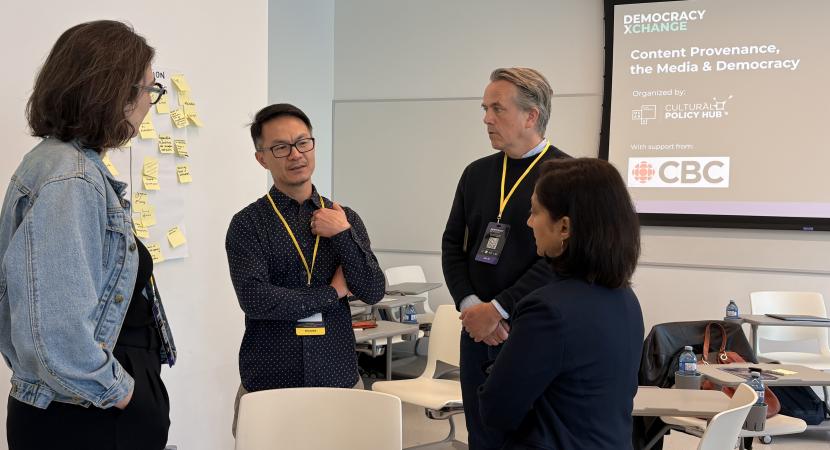
To address this challenge, the Cultural Policy Hub convened experts from media, government, tech, and civil society for a workshop on “Content Provenance, the Media, and Democracy” at the annual DemocracyXChange summit in April 2026. The workshop was designed with support from colleagues at Neural Transform and the CBC and facilitated by Aaron Williamson.
The goals of the workshop were:
- To explore how a voluntary Code of Practice could be structured and adopted to set standards for future regulation; and
- To ensure that provenance systems remain financially and technically accessible and are adopted by a wide range of users, including small media organizations, independent creators, and civil society groups.
Read the full Summary Report below: