Prime Time 2026: Ottawa gets Heated
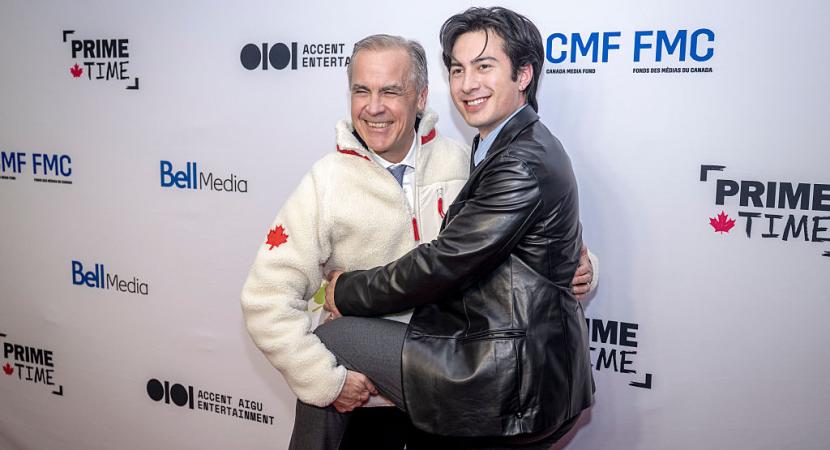
The deep-freeze of late January in Ottawa got a bit of a thaw with the arrival of Prime Time 2026, no doubt the hottest ticket in town that week. More than other creative industry conferences in recent memory, Prime Time featured a considerable dose of star-power, from on screen and on the Hill. There’s no question that the conference belonged to Heated Rivalry and its executive producers Jacob Tierney and Brendan Brady of Accent Aigu Entertainment, as well as to the creatives, cast, crew and team at Bell Media. Not a single panel or session went by without at least one reference to the Canadian smash hit that is winning over hearts and minds around the world. Photos and videos of Prime Minister Mark Carney and Hudson Williams (one of Heated Rivalry’s two stars) embracing on the red carpet went viral the next day.
Heated Rivalry is a global hit, and there’s no question that the industry and Canadians are proud. The story, setting and cast of characters are decidedly Canadian. The show wears its heart on its sleeve like Canadians do. The fact that it has been embraced by the world at this moment has made it an exemplar of what CanCon can be, and what “cultural sovereignty” can actually look like for Canada: a way of sharing our values and who we are as Canadians through our cultural works and products. As Minister of Culture and Canadian Identity Mark Miller said in both of his appearances at Prime Time, the show is giving us “a lot of bang for our buck.”
Cultural Sovereignty
Cultural sovereignty and the role that Canada’s creative content plays in these complex geopolitics were a key theme at Prime Time. In his first appearance at the conference since taking on his new Cabinet role in December 2025, just six weeks earlier, Minister Miller emphasized that Canadian culture is the “heartbeat of our nation,” and pledged continued support by the Government of Canada for the film and television industry.
In another appearance on the morning of January 30, Minister Miller announced that he would be launching an expert advisory council to advise him on the modernization of Canada’s audiovisual policy and programs. While it’s not clear what exactly this means, the fact that the announcement came right before a panel with the heads of the Indigenous Screen Office (ISO), Telefilm Canada, the National Film Board (NFB) and the Canada Media Fund (CMF) led many to speculate that the long-rumoured creation of a single agency for screen support in Canada is on the table. Miller offered no details or confirmation of this, other than to say that the ISO would remain separate from other federal agencies, a welcome clarification for the ISO and the industry.
During the panel with the four heads of the agencies, Kerry Swanson, CEO of the ISO, spoke about what cultural sovereignty means to Indigenous peoples of this land, referencing Prime Minister Carney’s speech at Davos in January 2026. In a clip from the panel shared by the ISO on social media, Swanson shared the following:
“When we talk about cultural sovereignty… I reflected on how [the Prime Minister’s Davos] speech could easily be applied to the Indigenous experience in Canada. So, the rupture has already happened here. Colonization was the rupture and it’s taken more than 200 years to just start to build to build back from that, to recover from the rupture. When he talks about ‘the strong do what they can and the weak suffer what they must,’ that has been the experience of Indigenous peoples in Canada and we can’t walk away from that fact. We have to confront that head-on. And Canada is the hegemon for us. They make the rules and we have to follow them. It has been a struggle to maintain our sovereignty, to have the rightful legal rights, the constitutional rights, the treaty rights. All of those were hard-won rights, fought for, for 200 years by Indigenous peoples to ensure that I can sit here in this chair as the first Indigenous-led arts and cultural funding agency in Canada and say that we are self-determined in the way that we run our organization.”
Swanson’s remarks are an important reminder that, in Canada, the term “cultural sovereignty” should be used thoughtfully. Canadians need to acknowledge that it is a complex concept: the assertion of Canadian cultural sovereignty through colonization has had profoundly negative impacts on First Nations, Métis and Inuit peoples. In this moment, cultural sovereignty has become a catch phrase that should be used with greater care and consideration for what it can mean for Canada if we are to recognize and address the inequities of the past and move forward with a truly inclusive vision for culture in this country, one that we share with the world.
A National Strategy for AI
Another main thread from the conference was AI. The Canadian Media Producers Association (CMPA) welcomed Evan Solomon, Minister of Artificial Intelligence and Digital Innovation, for a keynote that set out the Government’s intent to release a National AI Strategy that focuses on “AI for all.”
Minister Solomon said that the National Strategy for AI will be released in the first quarter of 2026, with three pillars: Build, Empower, and Protect. A core principle is that we must build Canadian sovereign systems so we are not dependent on others and invest in Canadian companies so they can scale. As the Minister said, Canada will no longer be the farm team for AI expertise and innovation from which other nations poach. Rather, he said, Canada will take a pragmatic approach where we preserve our values while building world-leading companies and capacity in AI. The AI Strategy will be consistent with the Government of Canada’s overall approach to build, buy and believe in Canada. A legislative package is underway and will include elements on safety, privacy and accountability, including online harms legislation led by Minister Miller.
What does the central principle of AI for all mean for the arts and creative industries, both in terms of having a voice in the development of the strategy, and for changes to cultural policy and legislation? That remains unclear.
Minister Solomon spoke about the National Summit on AI and Culture, which will be held on March 16–17 at the Banff Centre for Arts and Creativity. There were more questions than answers at Prime Time as to the Summit’s purpose and design, including: who has been included in the invitation-only event; what is the value of attending; and, most importantly, how it can impact a national strategy that is due for release so close to that same time? With the full cost of registration, travel and accommodation falling to participants, many small companies and not-for-profits may face barriers to participation. Whatever transpires in Banff, transparency and public reporting should follow the Summit, and a clear link between the discussion and government decisions around legislation and policy. Ongoing sector engagement will also be critical.
Prime Time 2026 also explored different dimensions of AI across several panels, keynotes and workshops. These ranged from a practical focus on the dozens of AI tools producers can use from early-stage development to post-production, to a panel I moderated titled “Ethical AI: What it means in practice.”
In this discussion, panelists Stephen Stohn, Marie-Julie Desrochers and Tejas Shah were asked: can AI be ethical? Can it be developed ethically? Can it be used ethically? The answer to the first: no, because AI is not human, it is a machine and cannot inherently behave ethically. To the questions of development and use, however, the panelists and the majority of the audience believe that it can be done ethically. Each panelist provided their perspective on how this can be achieved. Frameworks and protocols for regulation and AI usage emphasize the importance of transparency (both what content is being used to train AI systems and how it uses that content), remuneration and responsible use. The content industry should, according to the panelists, not accept an approach that sets only the minimum, or floor, for compliance. It should work together to ask for more, and should itself model how to reach a higher standard, where production is enhanced by the use of responsible AI tools but still recognizes and compensates artists and creators for use of their work and IP.
Conclusion
Overall, the mood at this year’s Prime Time was optimistic and proud. This in itself speaks to the power of great stories, brilliantly told. Heated Rivalry’s success was enough to turn what could have been a very different conference focused on the very real challenges of this moment into a celebration. Here’s hoping that momentum continues, but the hardest periods of the game are still to come.
Finally, it is impossible for me to write about Prime Time without acknowledging Catherine O’Hara’s death on Friday, January 30, 2026. The outpouring of grief for her loss has repeatedly referenced her kindness, her humour, as well as her immense creative genius. She was one of us, treasured in the industry, and she is missed.