Canada’s National AI Strategy: Key Overview and What It Means for Canada’s Arts, Culture, and Heritage Sector and Creative Industries
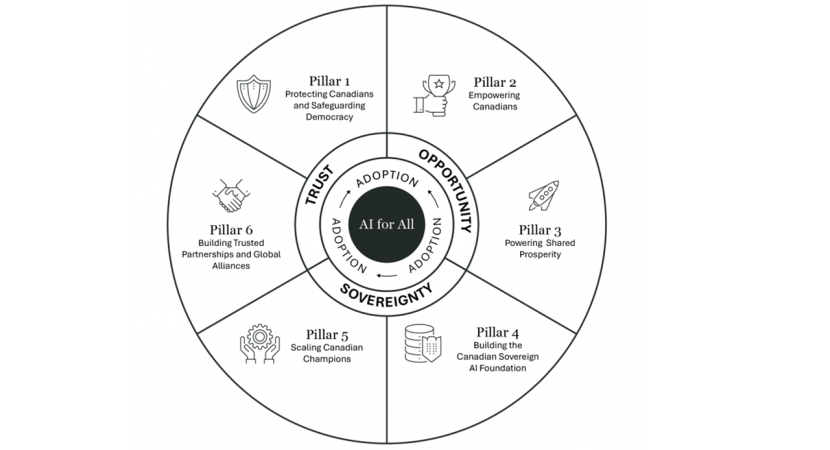
On June 4th, 2026, the federal government released Canada’s National Artificial Intelligence Strategy: AI for All. The Government’s stated intention is to promote AI adoption and bolster Canada’s global leadership in this field, putting AI to work “to grow our prosperity and wellbeing, promote our culture, and strengthen our communities.” The strategy sets out six pillars to this effect:
- Protecting Canadians and safeguarding democracy
- Ensuring AI empowers Canadians
- Powering shared prosperity
- Building the Canadian sovereign AI foundation
- Building and scaling Canadian AI champions
- Building trusted partnerships and global alliances.
This brief examines the contents of these pillars with an emphasis on the announcements that will matter most to Canada’s arts, culture, and heritage sector and creative industries. It also explores gaps and opportunities for these sectors.
Background
Since early 2025, the Government of Canada has been collecting input from Canadians to inform the development of its renewed artificial intelligence strategy, primarily through the AI National Sprint that Mark Carney’s government launched in October 2025. As part of this sprint, Innovation, Science and Economic Development Canada (ISED) ran a 30-day public consultation, which received submissions from over 11,300 respondents (including the Cultural Policy Hub). Feedback was also provided by interest holders during other engagement opportunities, such as the National Summit on AI and Culture in Banff.
On June 4th, 2026, ISED released Canada’s National Artificial Intelligence Strategy: AI for All. This strategy sets forth a number of initiatives to improve AI adoption and trust in Canada over the next five to ten years. This strategy attempts to fill the gaps left by the 2017 Pan-Canadian AI Strategy—which focused primarily on research and talent—and the proposed Artificial Intelligence and Data Act in 2022 (AIDA).
Pillar 1: Protecting Canadians and safeguarding democracy
The new National AI strategy acknowledges that “the risks of AI are real,” and that improving AI adoption and trust requires “a safety-first approach grounded in law.” Notably, the government states its intention to modernize consumer privacy legislation and introduce new online safety laws, with special attention to protecting children from exploitation and online harm. The strategy also signals the government’s intent to develop a Canada Trusted AI Certification program to help Canadians identify “trustworthy” AI products.
However, the strategy provides no practical details as to what these protection measures may entail, and if regulations and audits will apply to AI systems development, outputs, or actual user results. Most importantly, the strategy does not include a legislative timeline.
AI for All also affirms that Canada will continue to work on AI transparency, primarily “including capabilities like watermarking of AI-generated content,” and will aim to protect democratic institutions from AI‑enabled misinformation.
The strategy includes $50 million for the Canadian AI Safety Institute to continue tracking “emerging AI risks, advance technical research, and to conduct transparent evaluations of AI models.” However, when considering future legislation, it does not mention the possibility of liability laws.
Pillar 2: Ensuring AI empowers Canadians
The AI for All strategy announces the creation of a National AI Literacy Initiative, which would meet a long-time demand from Canadian businesses, including in the arts, culture, and heritage sector. The Initiative’s objective would be to “provide all Canadians with access to free AI literacy training”: this includes reaching 1 million entry-level post-secondary students and doubling K-12 teacher training to more than 3,000 educators, as well as investing $30 million into CanCode—a program which funds not-for-profit organizations to teach instructors and youth digital skills like coding and AI. All adults are meant to benefit from entry-level AI training under the National AI Literacy Initiative delivered through “public libraries [and] community organizations,” but no specific funding is earmarked to support this initiative.
Post-secondary students, meanwhile, will have access to “trusted AI agents.” The strategy does not specify how these agents will be developed, who will develop them, and what control universities will have to adopt and manage them.
Overall, the government aims to help create 250,000 new “AI-relevant” jobs by 2031. This figure is not explained in the strategy, and experts tend to be cautious in their estimation of the impact of AI on the labour market.
Among its other goals, Pillar 2 also aims to “ensure AI reflects Canadian identity, culture, and inclusion,” including by supporting Indigenous-led AI initiatives and adopting tools that protect and promote Indigenous and French languages. While the strategy does not explicitly speak to Indigenous sovereignty, it acknowledges the need for Indigenous agency and leadership over Indigenous data and AI tool development. The government intends to amplify Indigenous-led AI initiatives and to support “Indigenous self-determination over how AI is built and used in Indigenous contexts”.
For artists and creative industries specifically, the strategy plans for a new $50-million Creative Technology Program, which will support “Canadian creators in using AI on their own terms.”
The government also puts forth measures to critically evaluate gender-based bias in AI, to remove accessibility barriers from AI system and to drive inclusivity. It does not mention any specific measures against algorithmic bias based on race, religion, sexual orientation or other characteristics of identity or lived experience.
Pillar 3: Powering shared prosperity
The new National AI Strategy sets ambitious goals for AI adoption in Canada, aiming to improve the share of Canadian businesses (especially SMEs) that have adopted AI tools from 12% in 2025 to 60% by 2034. The government will utilize and expand programs such as the Business Development Bank of Canada’s LIFT Program, the Regional Artificial Intelligence Initiative, and the Small Business and Entrepreneurship Development Program.
It will also support the development of an AI Literacy and Adoption Assessment tool that SMEs and small businesses can use to measure their readiness to adopt AI solutions. This tool could be particularly effective in bridging the adoption gap and helping creators identify how to use AI to their advantage.
Also included is a new AI Missions Program to connect innovators, industries, and institutions and “to advance targeted, high-impact projects that deliver significant public good.” The first $200 million mission will be dedicated to Canadians’ health outcomes; in the future, a National AI Commons or Lab specific to arts, culture, and heritage could be explored through this avenue.
The strategy envisions the transformation of public service delivery through AI: it promises that a collaborative workflow between people and machines (a “human-in-the-loop" approach) will be maintained in the implementation of AI systems in public services, but does not mention the role of human contribution and decision-making oversight outside of the public service.
Pillar 4: Building the Canadian sovereign AI foundation
Sovereignty is one of the AI strategy’s pillars and positions the strategy in line with recommendations from experts and with past declarations about the importance of Canada’s sovereignty from Prime Minister Carney and Minister of AI and Digital Innovation Evan Solomon.
The strategy references previously announced initiatives, such as public-private initiatives around computing infrastructure and data centres, that will significantly increase Canada’s compute capacity by 2030—though it probably still won’t be enough for Canadian companies. The Government also promises to invest to build and reinforce secure digital systems used for Government operations, to invest in supply chain security, and to “anchor world-class research talent” in Canada through the Global Talent Stream.
“Data must be treated as a strategic national asset,” according to the strategy. But the Government’s approach is limited to health data for now, as neither cultural data nor Indigenous data are mentioned. Generally, the document fails to look beyond infrastructure to address legal sovereignty (CLOUD Act, data residency, model and training data control, etc.).
Pillar 5: Scaling Canadian champions
The strategy includes a number of new spending initiatives and increases to existing programs to build and scale investment in AI and access for Canadian companies to AI tools and compute. It establishes a $500-million Canadian Tech Growth Fund to provide capital to promising start-ups, and aims to leverage the Canada Strong Fund, a $25 billion “sovereign wealth fund” announced in April 2026.
The Government also sets out to provide an additional $700 million for the AI Compute Access Fund, which will enable SMEs including not-for-profit organizations to have an easier access to affordable sovereign compute. It will also invest $130 million for commercialization programs across the National AI Institutes.
To improve its export potential and avoid dependence on foreign models, Canada also plans to support the research and development of homegrown foundational models, intended to grow and scale internationally while remaining rooted in Canada.
The National AI strategy highlights the importance of the value of Canadian intellectual property (IP) and its commercial potential. The strategy points to the Elevate IP and IP Assist programs included in the 2025 Budget as a means to protect Canadian IP and support SMEs “to commercialize their intangible assets in the global marketplace.” However, the strategy offers nothing in terms of solutions to address the risks that AI model development can pose with respect to Canadian content creators’ IP.
Pillar 6: Building trusted economic and governance partnerships and global alliances
Carney’s government positions Canada as a potential world leader on AI governance, using its trusted position on the international stage and capabilities to promote “a global AI ecosystem that is open, secure, and aligned with democratic principles.” The newly formed Sovereign Technology Alliance, created by Canada and Germany in February 2026, could be extended to become a large coalition of democracies pooling resources and talent. This would also enable Canada to attract investments and to weigh heavier in the new and evolving context of AI diplomacy.
The government also promises to “lead a global, multi-stakeholder effort to invest in and sustain open-source AI development in the public interest.” Open-source AI has a lot of potential in terms of transparency, accountability, and external evaluation, making it especially appealing for the not-for-profit sector and for Canadians who are want ethically designed and produced tools and models to work with.
AI & Arts and culture
Since the AI National Sprint was announced, arts and culture sector interest holders have asked what role the Department of Canadian Heritage will play in AI policymaking. Following the National Summit on AI and Culture in March 2026, Minister Evan Solomon and Minister Marc Miller jointly announced the creation of an Advisory Council on AI and Culture to bridge the gap between the creative and technology sectors. The appointment of members to this council have yet to be announced.
As previously mentioned, the strategy sets aside a dedicated $50-million fund for artists and creative industries through the Creative Technology Program and promises to provide not-for-profit organizations with access to a variety of tools and funds to improve AI literacy and adoption. It also announced new funding for an AI Missions Program. While the first mission will be dedicated to healthcare, a future mission could be specific to arts, culture, and heritage.
However, the strategy misses the opportunity to support Canadian arts and culture where it matters most to them. Despite ongoing and vocal pressure from the arts and culture sector, the strategy does not address the ongoing issue of artists and creatives’ IP being used to train LLMs and other Generative AI tools and to inform those tools’ outputs. Solutions to these issues proposed by the sector—such as a licensing system covering such use with opt-in consent and fair compensation—are absent from the strategy. There is also no mention of potential reforms to current copyright law as a pathway to resolve these disputes.
Questions also remain as no commitments for specific Department spending have been attributed at this stage, and overall governance, policy ownership, and next steps on timelines and deliverables have not yet been laid out. The Cultural Policy Hub will continue to watch these issues with interest and will work with its partners at PCH, ISED, and across its network to share updates on the strategy’s implementation, including future opportunities and implications for the cultural sector and creative industries.